

HYPER-AI at Special Track Hyper-CC: Hyper-Distributed Systems and Applications for the Computing Continuum
30, April, 2026
·2 minutes read
·
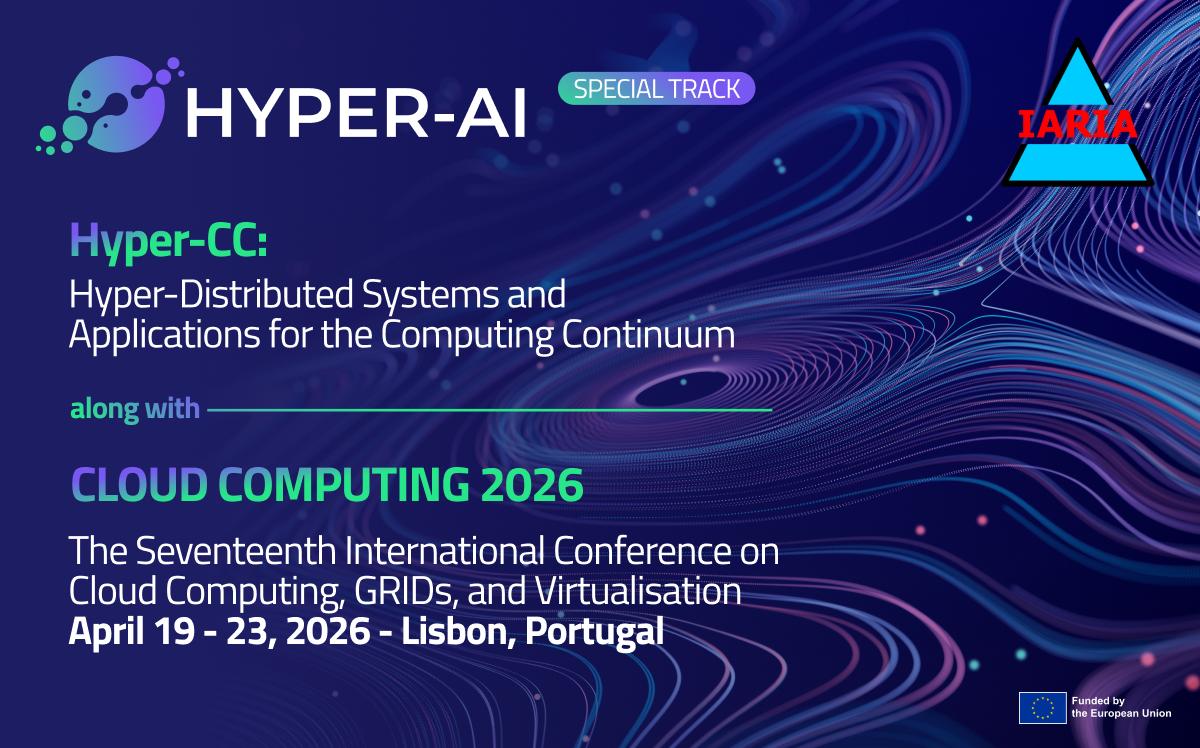
Last week, HYPER-AI was actively involved in the Special Track on Hyper-Distributed Systems and Applications for the Computing Continuum (Hyper-CC), organised within the Seventeenth International Conference on Cloud Computing, GRIDs and Virtualisation (Cloud Computing 2026), held in Lisbon, Portugal.
The Hyper-CC track brought together researchers and practitioners working at the forefront of distributed computing, providing a dedicated forum to explore how cloud, edge, and IoT infrastructures can be more effectively integrated into cohesive, intelligent, and scalable systems.
Advancing the Computing Continuum
As the demand for data-intensive and real-time applications continues to grow, traditional centralised approaches are increasingly challenged by fragmentation, heterogeneity, and scalability constraints. The Hyper-CC session addressed these issues by focusing on new models and tools for managing hyper-distributed environments, where resources and intelligence are spread across multiple layers of the computing continuum.
The contributions presented during the session reflected three complementary directions that are shaping the field:
- Platform-agnostic modelling of resources and applications, enabling more flexible and interoperable deployment across cloud, edge, and device environments
- Lifecycle management of heterogeneous nodes, addressing the complexity of orchestrating distributed infrastructures
- Simulation and evaluation frameworks for scheduling policies, supporting more robust and data-driven optimisation of resource allocation
Together, these approaches point toward a more structured and experimentally grounded way of designing and operating hyper-distributed systems.
From Orchestration to Intelligent Resource Management
Among the highlights of the session were contributions exploring learning-based scheduling strategies, capable of improving resource management across the computing continuum, and approaches for describing and orchestrating applications in heterogeneous environments through unified and platform-independent models.
The session concluded with work on tools such as Hypertool, focusing on simplifying the management of distributed infrastructures through resource abstraction, orchestration, and lifecycle control. These developments reflect a growing need to make complex systems more manageable, efficient, and accessible for developers and operators alike.
Strengthening Research and Collaboration
The Hyper-CC Special Track reinforced the importance of collaboration between European research initiatives working on the Computing Continuum. By bringing together diverse perspectives (from system modelling to AI-driven orchestration) the session contributed to advancing a shared vision of interoperable, scalable, and intelligent digital infrastructures.
For HYPER-AI, participation in this track represented an important step in engaging with the wider research community and contributing to the evolution of hyper-distributed computing. It also aligns with the project’s broader objective of enabling autonomous, energy-efficient, and adaptive AI systems across cloud-edge-IoT environments.
As research in this domain continues to evolve, initiatives like Hyper-CC play an essential role in bridging theoretical advances with practical solutions, helping to shape the future of distributed computing in Europe and beyond.